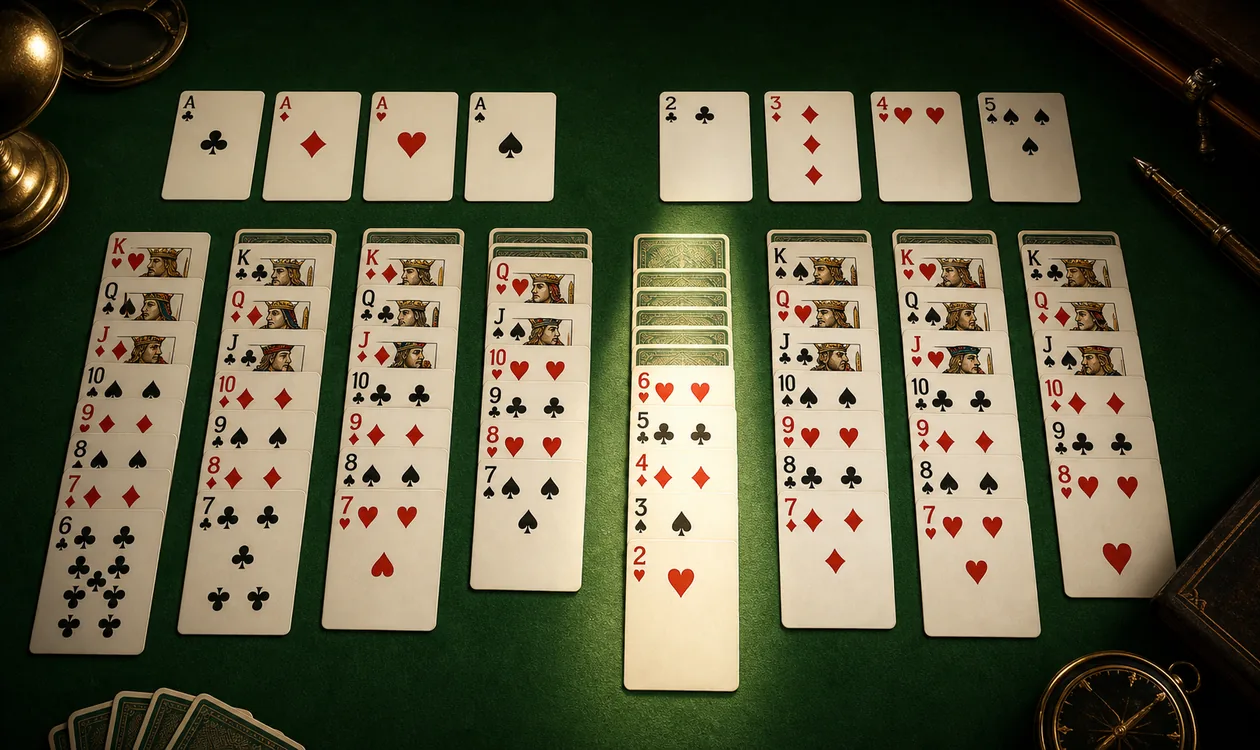
Once you have mastered the basic rules and developed a solid strategic foundation, Yukon Solitaire opens up into a richly complex game with layers of tactical nuance. Advanced play is not about knowing special tricks or hidden mechanics. It is about developing sharper pattern recognition, deeper planning horizons, and more precise move evaluation. The difference between an intermediate player and an advanced player is not the number of moves they make but the quality of the decisions behind each move.
Advanced players see the tableau differently from beginners. Where a beginner sees a collection of unrelated cards, an advanced player sees a network of potential move chains, dependencies, and bottlenecks. Every card has a role: some are blockers, some are enablers, some are foundation candidates waiting for the right moment. Learning to classify cards by their strategic function rather than by their rank and suit alone is a key step in advancing your play.
The most important skill for advanced play is multi-step planning. Beginner plans typically extend one or two moves ahead. Intermediate players plan three to five moves ahead. Advanced players routinely plan ten to fifteen moves ahead, and exceptional players can see twenty moves or more into the future. Developing this skill requires practice, but there are specific techniques you can use to accelerate your progress.
Recognize Solvable vs Unsolvable Layouts
One hallmark of an advanced Yukon player is the ability to recognize early in a game whether a layout is solvable. Not every deal can be won in Yukon Solitaire. The win rate across random deals is roughly thirteen to fifteen percent, meaning most layouts are not solvable no matter how well you play. Recognizing an unsolvable layout early saves you time and frustration, allowing you to move on to the next deal without investing significant effort in a lost cause.
The key indicators of an unsolvable layout include Aces buried under deep piles of unrelated cards with no clear path to extract them, Kings that are trapped in columns where the cards above them cannot be moved because there is no suitable destination, and severe color imbalance where most cards of one color are concentrated in columns that block each other. If you see these patterns in the first few moves, the layout is likely unsolvable and you should start a new game rather than struggle through a losing battle.
However, be careful not to give up too early. Some layouts that look unsolvable at first become solvable after a clever chain of moves. Advanced players develop a feel for which blocked-looking layouts have hidden solutions and which ones are truly hopeless. This intuition comes from experience, so do not be discouraged if you cannot always tell the difference at first.
Optimize Move Count for Efficiency
Efficiency matters in Yukon Solitaire, especially in digital versions that track your move count. Every move you make should serve a clear purpose. Unnecessary moves not only increase your move count but also risk creating new problems. Before making any move, ask yourself what specific goal it advances. If you cannot articulate a clear goal, the move is probably unnecessary.
One way to reduce unnecessary moves is to combine objectives. A single group move can uncover a face-down card, reposition a useful sequence, and free up a column for a King — all in one action. Look for moves that serve multiple purposes and prioritize them over moves that only accomplish one thing. Efficiency is not about speed. It is about maximizing the value of each action.
Another efficiency technique is to avoid moving cards to the foundation and then back to the tableau. Once a card is on the foundation, it cannot be retrieved. But some players make the mistake of moving a card to the foundation prematurely and then needing it on the tableau later. If you catch yourself wishing you had not moved a card to the foundation, take that as a lesson in patience. Delaying foundation moves until they are clearly safe is a hallmark of efficient play.
Use Color Alternation Patterns
Color alternation is the foundation of tableau building in Yukon Solitaire, but advanced players use color awareness in subtler ways. For example, if you notice that most of the remaining face-down cards are in columns of one color, you can prioritize exposing those columns because they are more likely to contain cards of the opposite color that will extend your sequences. Color tracking helps you predict what is under face-down cards and make better decisions about which columns to pursue.
Advanced players also use color alternation to create artificial bottlenecks. If you have two columns that each contain a long alternating sequence, you can deliberately break one sequence to extend the other, effectively transferring the bottleneck from one column to another. This technique requires careful planning but can be decisive in tight layouts where every move matters.
Practice With Difficult Layouts
The best way to improve at Yukon Solitaire is to practice with difficult layouts. Easy layouts do not challenge your strategic thinking. They allow you to win without developing the skills needed for harder deals. Seek out layouts that require long move chains, multiple column clears, and careful foundation timing. These are the layouts that will stretch your abilities and teach you new patterns.
When you lose a game, take a moment to review why. Was there a critical move you missed? Did you move a card to the foundation too early? Did you fill an empty column without a clear plan? Every loss is a learning opportunity, and advanced players treat losses as more valuable than wins because losses reveal weaknesses that wins can hide.
To put these tips into action, play solitaire yukon free and focus on one specific technique each session. In one session, concentrate on multi-step planning. In another, focus on move efficiency. In a third, practice recognizing unsolvable layouts. Deliberate practice with a focused objective will improve your skills faster than casual play, and before long you will see your win rate climb and your move counts decrease as you develop true mastery of Yukon Solitaire.