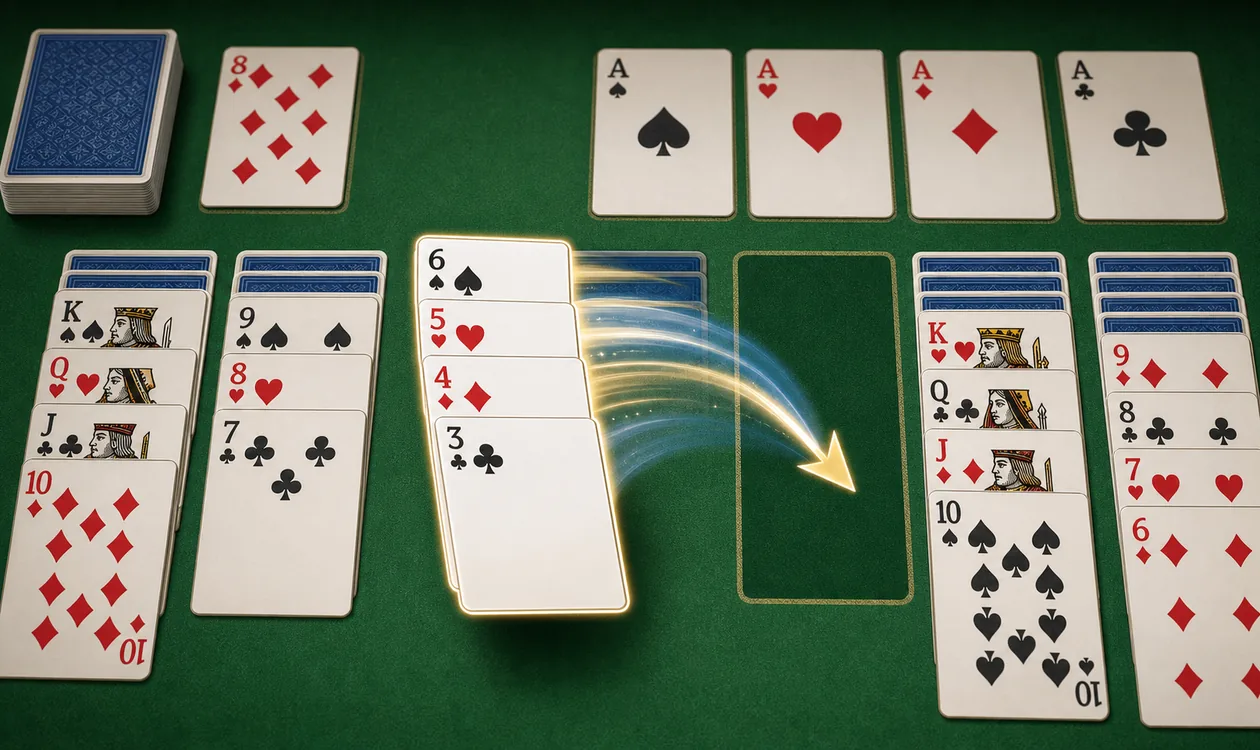
Card movement is the heart of Yukon Solitaire, and the game's unique movement rules are what set it apart from every other solitaire variant. Understanding how to move cards effectively — both individually and in groups — is the single most important skill you can develop as a player. Unlike Klondike, where you can only move the top card of a pile, Yukon allows you to reach into the middle of a column, grab a card, and pull all the cards above it along for the ride. This one rule change transforms the game from a straightforward sequencing exercise into a dynamic puzzle with rich tactical possibilities.
The movement rules in Yukon Solitaire are simple to describe but deep in their implications. You can move any face-up card from any position in a column, provided that when you place it on a target column, the card forms a descending alternating-color pair with the target column's bottom card. The cards that were above the moved card come along automatically, regardless of whether they are in sequence with each other or with the moved card. This means you can reposition large groups of cards in a single move, potentially changing the shape of the entire tableau in one action.
The key to mastering card moves in Yukon is learning to evaluate which moves are worth making and which ones create more problems than they solve. Every move has cascading effects. Moving a card from the middle of a column exposes whatever was underneath it, which is usually good because it reveals hidden information. However, it also relocates a potentially useful sequence to a different column, which may not be ideal if that sequence was needed elsewhere. Good move selection is about balancing immediate gains against long-term positioning.
Single Card Moves vs Group Moves
Single card moves are the simplest type of move in Yukon Solitaire. You move one exposed card from the bottom of a column to the bottom of another column where it forms a valid descending alternating-color pair. Single card moves are useful for fine-tuning the tableau, adjusting sequences by one card at a time, and gradually shaping columns toward your desired configuration. They are low risk because they only change the state of two columns by a single card each.
Group moves are where Yukon gets interesting. A group move occurs when you pick a card that is not at the bottom of its column. All the cards from that position upward move together to the destination column. The group can contain any number of cards, and those cards do not need to be in any particular order. For example, suppose column three has, from bottom to top: King of Spades, Five of Diamonds, Two of Clubs, and Eight of Hearts. If you grab the Five of Diamonds and move it to a column showing a Six of Clubs, the Five, Two, and Eight all move together. The King stays behind and is now exposed as the bottom card of column three.
Group moves are powerful because they can uncover multiple face-down cards at once and reposition large blocks of cards efficiently. The trade-off is that group moves are harder to reverse. If you move a group to the wrong column, untangling the resulting mess can cost several turns. Use group moves when you have a clear objective in mind — uncovering a face-down card, freeing a King, or consolidating a suit for foundation building — rather than as an exploratory tactic.
Reading the Tableau for Move Opportunities
Before making any move, scan the entire tableau for opportunities. Yukon Solitaire rewards players who see the full board rather than fixating on one column. Look for cards that are one rank below and opposite color to the bottom cards of other columns. These are your potential move targets. When you find a match, evaluate whether making the move would improve the board state. Consider what card would be exposed by the move, whether that card would be useful, and whether the destination column would benefit from receiving the new card or group.
Pay special attention to columns that contain multiple cards of the same suit or alternating colors stacked in sequence. These columns are prime candidates for group moves because the cards are already partially organized. If you can relocate an entire sequence to another column where it continues a longer chain, you effectively extend that chain without having to rebuild it from scratch. This is particularly valuable when building sequences under Kings in empty columns.
Also watch for blocked columns where a high-value card such as an Ace or a low-numbered card is buried under unrelated cards. If you can find a way to extract that buried card and move it to a more useful location, you may unlock previously impossible moves. The ability to grab cards from the middle of a column makes Yukon uniquely suited for rescuing trapped cards, a capability that Klondike players can only dream of.
Using Empty Columns for Card Movement
Empty columns serve as staging areas for card movement in Yukon Solitaire. When you clear a column, you gain the ability to reposition Kings and their attached groups. This is often the first step in a multi-move sequence that transforms the entire tableau. For example, if you have a King buried under several cards in column seven and an empty column available, you can gradually move the obstructing cards to other columns, extract the King, move it to the empty column, and then rebuild the sequence under the King.
The empty column can also be used temporarily as a holding area for cards that are in the way. If you need to access a card deep in a column, you can move the obstructing cards to the empty column, make your move, and then return the obstructing cards to their original positions or rearrange them elsewhere. This technique is essentially a multi-step group move that uses the empty column as intermediate storage. It requires more moves than a direct group transfer but offers greater precision.
Move Sequencing and Chain Building
Chain building is the art of making a series of moves where each move creates the opportunity for the next. In Yukon Solitaire, chains of five to ten moves are common, and experienced players routinely plan chains that extend beyond twenty moves. The key to building effective chains is to always have a next move in mind before you make the current one. If you make a move without knowing what you will do afterward, you are likely playing reactively rather than strategically.
Start each chain with a clear objective. Your objective might be to uncover a specific face-down card, to free a particular King, or to create an empty column. Then work backward from that objective to identify the card that needs to move first. Then identify what needs to happen to make that card available. Continue this backward planning until you reach a move that you can make immediately. Execute the chain, and if any step fails because the board state changes unexpectedly, reassess and find a new path.
One helpful technique is to practice on simpler layouts first. While you can explore yukon solitaire play instantly and experiment with different move sequences, taking notes on which approaches succeed and which fail will accelerate your learning. Over time, you will develop an intuitive sense for which moves lead to productive chains and which ones create dead ends. That intuition is the hallmark of a skilled Yukon player.
Avoiding Common Movement Mistakes
The most common movement mistake in Yukon Solitaire is moving a card to the foundation too early. As discussed in the strategy article, cards on the foundation are permanently removed from the tableau. If that card was needed to maintain a sequence or to provide a landing spot for another card, its early departure can derail your entire plan.
Another frequent mistake is moving a group of cards without checking whether the destination column already contains useful sequencing. If you drop a group onto a column that was already well organized, you may have to spend several moves later to restore the original order. Always check the destination column's existing sequence before committing a group move.
Finally, avoid the temptation to fill every empty column immediately. An empty column is a resource. You can use it for temporary storage, for King placement, or as a waypoint in a complex chain. Once you fill it, you lose that flexibility. Keep columns empty until you have a specific, strategic reason to fill them, and you will find that your move options remain open longer.