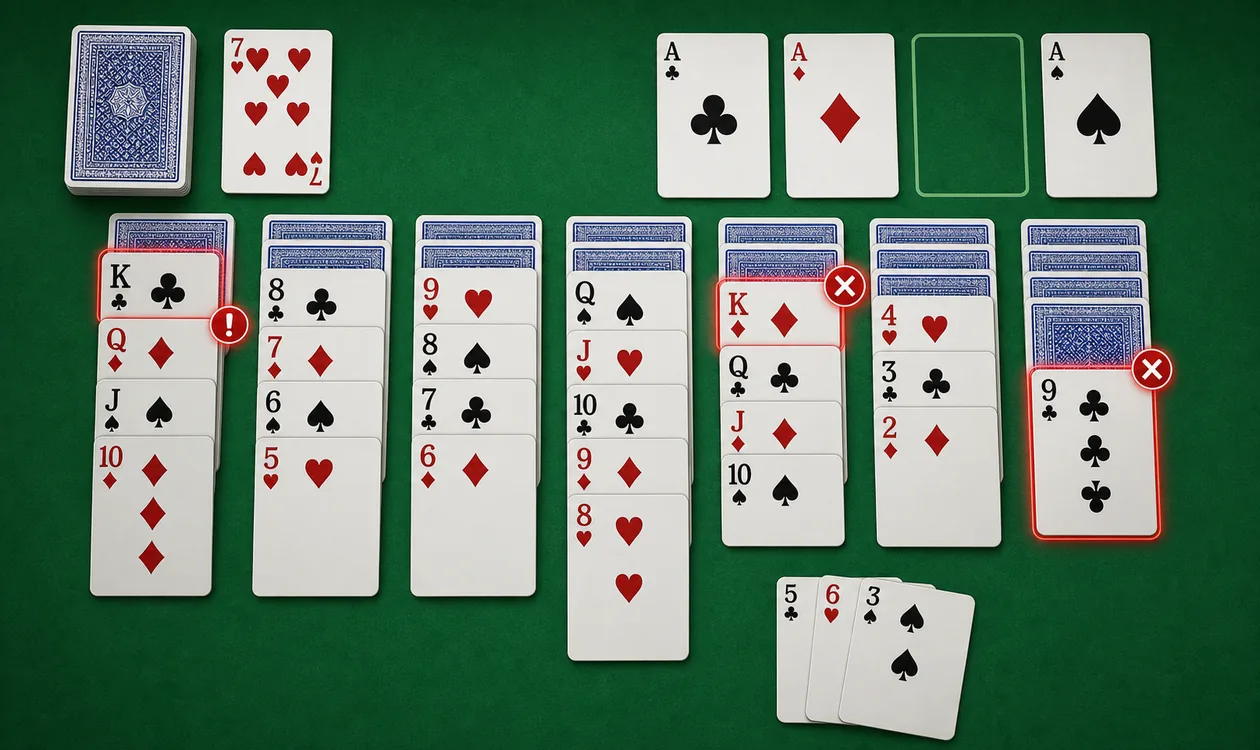
Even experienced Yukon Solitaire players make mistakes. The game's complexity means that small errors in judgment can compound over the course of a deal, turning a promising layout into a frustrating dead end. The good news is that most mistakes follow predictable patterns. Once you learn to recognize these patterns, you can avoid them and significantly improve your win rate.
This article catalogues the most common mistakes players make in Yukon Solitaire and provides practical, actionable fixes for each one. Whether you are a beginner who just learned the rules or an experienced player looking to refine your technique, reviewing these mistakes will help you identify areas where your own play could improve. Keep in mind that even the best players make errors from time to time. The goal is not perfection but steady progress toward cleaner, more thoughtful play.
The mistakes are organized by category. Some relate to strategic planning, others to move execution, and others to foundation management. Read through all of them, then try a few games with one specific mistake in mind. Focused practice on a single error pattern is the fastest way to eliminate it from your play.
Mistake 1: Moving Cards to the Foundation Too Early
This is by far the most common mistake in Yukon Solitaire. Players see that a card is eligible for the foundation and move it there immediately, without considering whether the card is still useful on the tableau. In Klondike, early foundation moves are generally safe because the stock pile provides backup options. In Yukon, every card you remove from the tableau reduces your flexibility, and some cards are essential for maintaining tableau sequences.
For example, suppose the hearts foundation needs a Four of Hearts, and you have a Four of Hearts exposed in column three. Moving the Four to the foundation seems correct. But if that Four is currently the only card that can receive a Five of Hearts from column five, and column five is blocking a face-down card, then moving the Four early forces you to find an alternative landing spot for the Five, which may not exist. The result is a blocked column that could have been avoided by waiting a few more moves.
The fix: Before moving any card to the foundation, scan the tableau for cards that are one rank higher and the same suit. If any such card exists and is not yet eligible for the foundation, check whether it currently relies on the card you are about to move. If there is a dependency chain, leave the card on the tableau until the dependent cards have been resolved. A good rule of thumb is to delay foundation moves until at least half of the face-down cards have been uncovered.
Mistake 2: Ignoring Face-Down Cards
Some players become so focused on building long alternating sequences and clearing columns that they lose track of the face-down cards still buried in the tableau. Every face-down card you leave unexposed is a potential Ace, King, or critical linking card that could unlock the entire layout. Ignoring face-down cards is like playing poker without looking at your hole cards — you are making decisions with incomplete information.
The fix: After every third or fourth move, take a moment to count how many face-down cards remain in each column. Prioritize moves that expose these cards. If a move does not expose at least one face-down card, ask yourself whether there is an alternative move that does. In the early game, exposure should be your primary objective. In the late game, when most face-down cards are already flipped, you can shift focus to foundation building and sequence completion. If you want to enjoy the yukon solitaire bliss of a perfectly executed game, make face-down card exposure your top priority from the first move.
Mistake 3: Filling Empty Columns Too Quickly
Empty columns are valuable real estate in Yukon Solitaire. They provide a place to park Kings, a staging area for complex move sequences, and a way to reorganize the tableau without disturbing existing sequences. Many players make the mistake of filling an empty column as soon as it appears, often with a King that is not yet strategically positioned or with a group of cards that would be better placed elsewhere.
The fix: Leave empty columns open until you have a clear strategic reason to fill them. An empty column is not a problem to be solved — it is a resource to be used. If you have a King that is currently blocking useful cards, that King is a good candidate for the empty column. If you have a King that is already well positioned, moving it to the empty column may not improve the board state at all. Be selective about which Kings you move into empty spaces and when.
Mistake 4: Overlooking Group Move Opportunities
Because Yukon Solitaire allows group moves, players who are used to Klondike sometimes forget that they can move cards from the middle of a column. They focus exclusively on the bottom card of each column and miss opportunities to extract buried cards or reposition large groups in a single move. This is a classic case of old habits interfering with new gameplay.
The fix: Train yourself to scan the entire column, not just the bottom card. When you look at a column, mentally note every face-up card and consider whether each one could be useful elsewhere. If a card is one rank below and opposite color to the bottom card of another column, you can move that card and everything above it. This is especially powerful for extracting cards that are buried deep in a column and for transferring long sequences between columns without rebuilding them card by card.
Mistake 5: Playing Too Fast Without a Plan
Yukon Solitaire rewards patience and punishes haste. When you play quickly without a clear plan, you make reactive decisions rather than strategic ones. A reactive decision might solve an immediate problem but create two new problems down the line. The player who pauses before each move and considers the implications will consistently outperform the player who rushes through the game.
The fix: Before making any move, pause for three seconds and ask three questions: What card will this move expose? Does that exposed card help me? What will my next move be after this one? If you cannot answer all three questions, take more time to think. Speed will come naturally as your pattern recognition improves. Forcing speed before you have the patterns internalized will only reinforce bad habits. Take your time, plan your moves, and let speed develop as a byproduct of skill rather than a goal in itself.
Mistake 6: Uneven Foundation Building
Building one foundation far ahead of the others is a common strategic error. If you focus exclusively on the hearts foundation, for example, you may use up all the red cards that could have been used for alternating sequences in the tableau. The remaining black cards then have fewer landing spots, and the columns become harder to manage.
The fix: Try to keep the foundations roughly balanced. When you have a choice between moving a card to a foundation that is ahead and moving a card to a foundation that is behind, prefer the behind foundation. Balanced foundations create more tableau flexibility because the tableau retains a mix of ranks and suits. This is particularly important in the late game when the remaining tableau cards are few and every sequence counts.
Mistake 7: Not Reviewing Lost Games
The most preventable mistake is failing to learn from your losses. Every lost game contains information about what went wrong, but many players immediately start a new game without reflecting on the previous one. Over time, this means the same mistakes repeat across dozens or hundreds of games without improvement.
The fix: After every loss, spend thirty seconds reviewing the final board state. Identify the last two or three moves before the game became blocked. Ask whether a different choice would have kept the game alive. If you spot a pattern — for example, you frequently lose because you fill empty columns too early — focus on that pattern in your next session. A small investment in post-game review will yield outsized returns in your skill development over time.