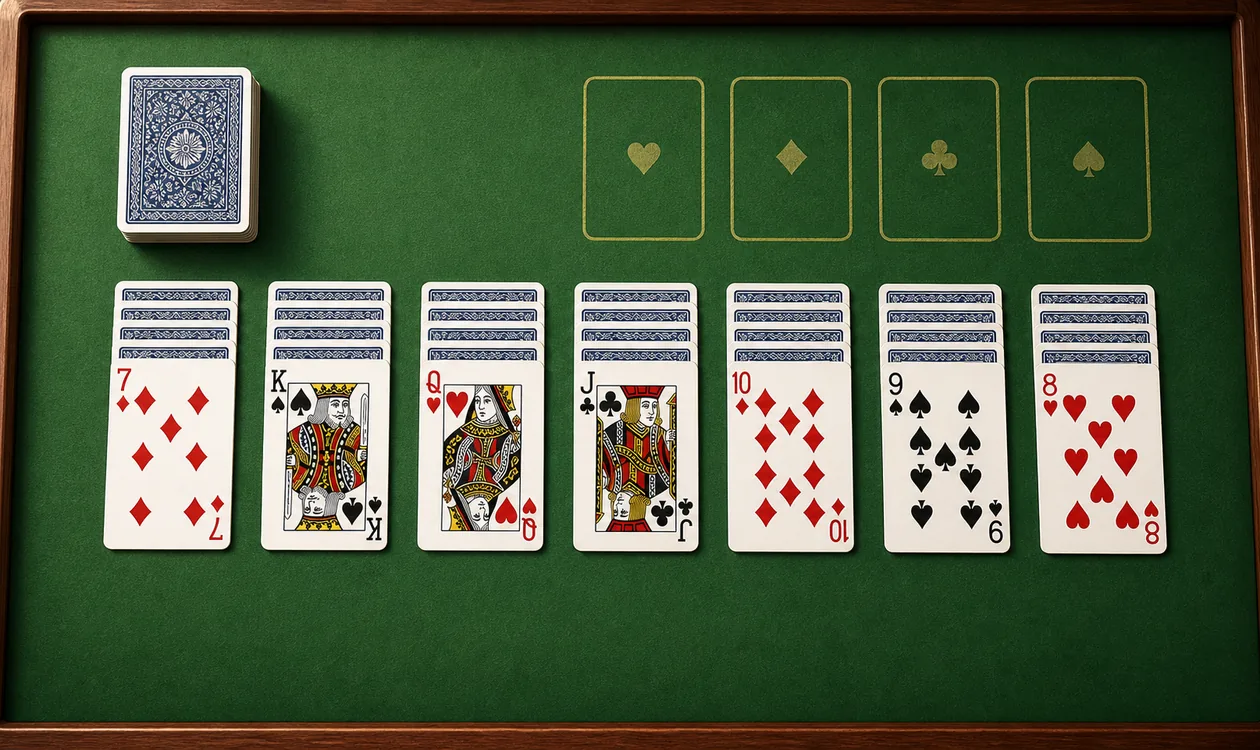
Yukon Solitaire is a challenging one-player card game that belongs to the Klondike family but introduces several important differences that change the way you plan and execute moves. The goal is the same as most solitaire games: move all fifty-two cards to four foundation piles, sorted by suit in ascending order from Ace to King. However, the path to that goal is quite different from what you might expect if you have only played Klondike or FreeCell.
The most notable feature of Yukon Solitaire is that every card is dealt on the tableau at the start of the game. There is no stock pile, no waste pile, and no way to draw additional cards. This means the cards you see during the initial deal are the only cards you will have for the entire game. You must rearrange, sequence, and transfer cards between columns using only what is already on the table. This makes Yukon a pure test of tableau management and forward planning rather than a game of chance from a draw pile.
Another defining feature is the ability to move any face-up card regardless of its position within a column. In Klondike, you can only move the top card of a pile. In Yukon, if you want to move a card that is buried two or three layers deep, you can do so. All the cards sitting above it move along automatically as a group. Those cards do not need to be in any particular order or sequence. The only requirement is that the top card of the moving group forms a valid descending sequence with alternating colors when placed on the target column.
Tableau Setup and Initial Deal
Yukon Solitaire uses a standard fifty-two-card deck with no jokers. The tableau consists of seven columns arranged from left to right. The setup is similar to Klondike in terms of column sizes but differs in how many cards are face up versus face down. Column one has one card, column two has two cards, column three has three cards, and so on up to column seven which has seven cards. The bottom card of each column is dealt face up. The remaining cards in each column are dealt face down in a stack above the face-up card.
After dealing the initial face-up cards, an additional four face-up cards are added to each of the six columns on the right, from column two through column seven. This means column one has one face-up card and no face-down cards. Column two has two cards total: one face-down card on the bottom and one face-up card on top. Column three has three cards total: one face-down and two face-up. This pattern continues so that column seven has seven cards total: one face-down card at the bottom and six face-up cards above it. In total, there are twenty-one face-down cards and thirty-one face-up cards on the tableau.
The four foundation piles are placed above the tableau. They start empty. Aces are moved to the foundations as they become available and exposed during play. The foundations are built up in suit order from Ace to King. For example, the Ace of Spades starts the spades foundation, followed by the Two of Spades, Three of Spades, and so on up to the King of Spades.
Building Sequences on the Tableau
The tableau columns are built downward in descending order with alternating colors. This is the same rule used in Klondike. A red card must be placed on a black card, and the rank must be exactly one lower. For example, a red Eight of Hearts can be placed on a black Nine of Spades. A black Seven of Clubs can be placed on a red Eight of Diamonds. You cannot place a card of the same color on another card, and you cannot skip ranks. Sequences must be strict alternations of color with consecutive descending ranks.
What makes Yukon different is that you can move a group of cards at once even if the cards within the group are not in perfect sequence. The group does not need to be ordered. As long as the bottom card of the group (the card that will make contact with the target column) forms a valid descending alternating-color pair with the target card, the entire group moves. This rule opens up creative move possibilities that do not exist in Klondike. You can pick up a mixed group of cards from the middle of a column and reposition it elsewhere, potentially uncovering face-down cards or freeing up space for Kings.
When a face-down card becomes the top card of a column after the cards above it have been moved away, you flip it face up immediately. That freshly exposed card may then be available for play. Revealing face-down cards is one of the most important objectives in Yukon Solitaire, because each hidden card you uncover increases your options and brings you closer to solving the layout.
Foundations and Winning the Game
The four foundations are built independently by suit. Each foundation starts with an Ace and builds upward to the King. Only the top card of a tableau column can be moved to a foundation, and it must be the next card in the suit sequence. For example, if the hearts foundation currently shows the Five of Hearts, you can move the Six of Hearts onto it, provided the Six is exposed at the bottom of a tableau column.
Unlike some solitaire games, cards moved to the foundation in Yukon cannot be retrieved. Once a card is placed in a foundation, it stays there for the rest of the game. This means you should be strategic about when to move cards to the foundation. If moving a card to the foundation would break a useful tableau sequence or leave a column blocked, it may be better to postpone the foundation move until a more convenient moment.
You win the game when all fifty-two cards have been moved to the four foundation piles. Each foundation will contain thirteen cards in sequence from Ace to King for its respective suit. If you reach a point where no further moves are possible and cards remain on the tableau, the game is lost. Because there is no stock pile, a dead end is final. This is what makes Yukon Solitaire more difficult than Klondike and more satisfying to solve.
Empty Column Rule
When a tableau column becomes completely empty, only a King or a group of cards headed by a King can be placed into that empty space. This rule is identical to Klondike. The King acts as the foundation of a new column sequence. If you have multiple Kings in play, each one can start a fresh column in an empty slot. This is why experienced players try to clear at least one column early in the game. An empty column gives you a place to park a King and the cards stacked on top of it, which can unlock otherwise blocked sequences.
If you clear multiple columns but do not have enough Kings to fill them, the extra empty columns provide no additional benefit. This is a common strategic mistake among new players who over-prioritize clearing columns without considering whether they have Kings available to fill the gaps.
Common Rule Variations
Different digital and physical versions of Yukon Solitaire may include minor rule variations. Some versions allow wrapping from King to Ace, meaning a King can be placed on an Ace in the tableau. Other versions do not permit wrapping and treat Ace and King as disconnected ends of the rank spectrum. Most digital versions do not allow wrapping, and we recommend playing without it for consistency with standard rules.
Some versions also use a different deal where all cards are face up from the start with no face-down cards at all. This version is sometimes called Open Yukon or Face-Up Yukon and is significantly easier because there are no hidden cards to worry about. The standard version, as described in this guide, includes face-down cards and offers a more balanced challenge.
Once you feel comfortable with the basic rules, the next step is to develop a solid strategy. Understanding when to move cards to the foundation, when to prioritize uncovering face-down cards, and how to manage empty columns will dramatically improve your win rate. To get started, enjoy solitaire yukon free right now and practice the rules described above. Every deal is a new puzzle, and the satisfaction of solving a difficult layout makes every game worth playing.