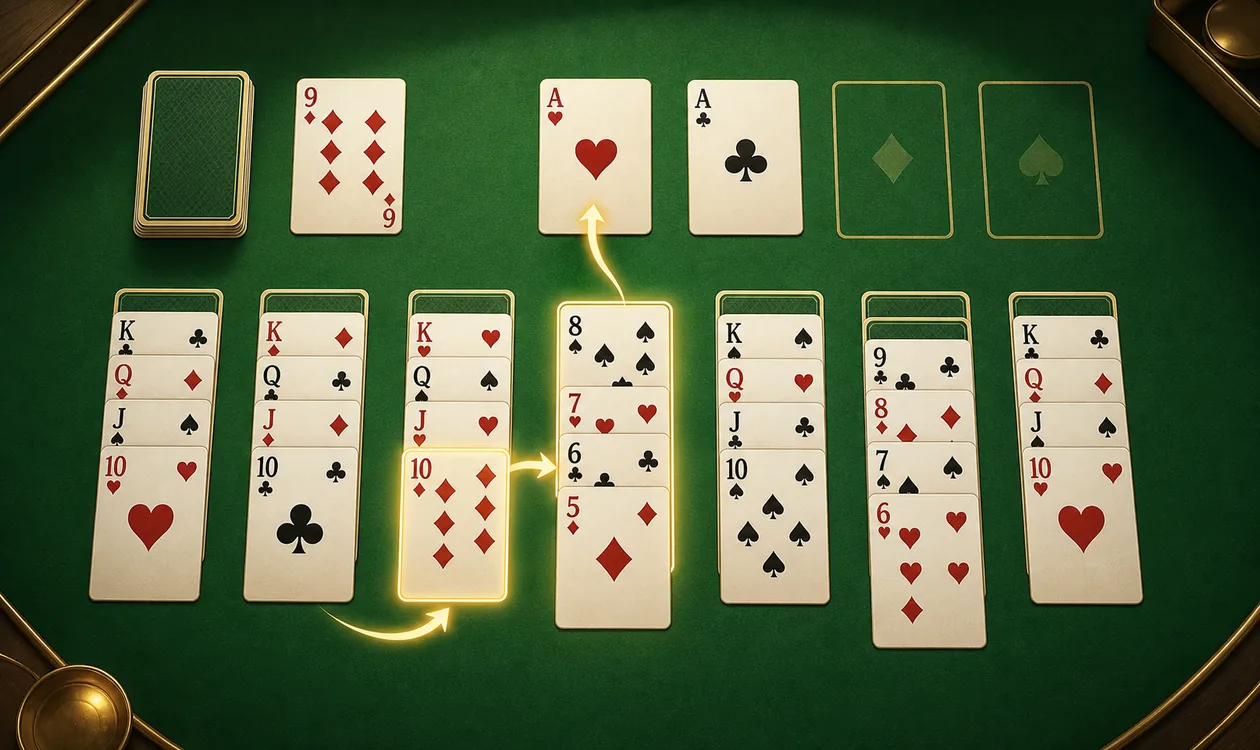
Yukon Solitaire is a game of strategy rather than luck. Because there is no stock pile, every card you need is already on the table in front of you. The challenge is not discovering new cards through draws but figuring out how to rearrange the existing cards into winning sequences. This makes strategy more important in Yukon than in almost any other standard solitaire variant. A thoughtful approach can double or triple your win rate compared to playing by instinct alone.
New players often approach Yukon the same way they approach Klondike — they move cards to the foundation as soon as possible, clear short columns first, and generally react to the board rather than plan ahead. These habits work reasonably well in Klondike because the stock pile can rescue you from bad decisions. In Yukon, there is no rescue. Every move has lasting consequences, and a single mistake can make the difference between a solvable layout and a dead end. Developing good strategic habits from the beginning will serve you well as you progress to harder deals.
The most important strategic principle in Yukon Solitaire is to prioritize uncovering face-down cards above almost everything else. Face-down cards are the only unknown variable in the game. Every card you flip gives you more information and more options. A move that exposes a face-down card is almost always better than a move that simply rearranges face-up cards without revealing anything new. This principle should guide your decision-making throughout the game, especially in the early and middle stages.
Uncover Face-Down Cards First
The twenty-one face-down cards in the tableau are the biggest obstacle between you and victory. Until you flip them, you do not know what resources you have available. An Ace might be buried under a stack of unrelated cards. A much-needed King might be hiding in a column you have been ignoring. The sooner you expose these cards, the sooner you can incorporate them into your plan.
To uncover face-down cards efficiently, focus on moving cards from columns that have the most face-down cards remaining. The deepest columns — columns six and seven — typically have the most hidden potential. If you can make progress on those columns early, you will likely reveal more useful cards than if you focus on the shallow columns. However, do not ignore the shallow columns entirely. Column one has only one face-up card and no face-down cards at all. Clearing it completely creates an empty column for a King, which is valuable in its own right.
When deciding between two moves that both uncover face-down cards, choose the move that uncovers the deeper column. For example, if you can move a Seven from column six to column three, and also move a Seven from column four to column two, the move from column six is usually more valuable because it exposes a card from a deeper stack. The exception is when column three or column two is close to being completely cleared, in which case the shallower move may create an empty column sooner.
Manage Empty Columns Strategically
Empty columns are one of the most powerful tools in Yukon Solitaire because they allow you to reposition Kings and the groups of cards stacked on them. However, empty columns are only useful if you have a King ready to fill them. If you clear a column and no King is available to move into the empty space, you have not gained any strategic advantage. In fact, you may have lost sequencing flexibility by removing a column that previously held useful cards.
A better approach is to clear a column only when you have a specific King in mind to place there. Scan the tableau for Kings that are buried under other cards. If you see a King that is two or three cards deep in a column, plan a series of moves that will free that King and move it to the empty column. The empty column becomes a staging area where you can build a sequence under the King without interference from other columns.
If you have multiple empty columns but only one or two Kings available, do not clear additional columns unnecessarily. Extra empty columns do not multiply your options. They simply sit empty until a King arrives, and in the meantime you have lost the card-storage capacity those columns provided. Clear columns deliberately, not automatically.
Build Foundations Strategically
Many beginners rush to move cards to the foundation as soon as they become eligible. In Yukon Solitaire, this can be a costly mistake. Moving a card to the foundation removes it from the tableau permanently. If that card was part of a useful tableau sequence, you may have broken a chain that could have helped you uncover multiple face-down cards.
A better strategy is to delay foundation moves until the card in question is no longer needed on the tableau. For example, if you have a Two of Hearts that can move to the hearts foundation but also serves as the only legal landing spot for a Three of Hearts currently blocking a face-down card, keep the Two on the tableau until the Three has been moved elsewhere or the face-down card has been uncovered. Once the card is no longer strategically useful on the tableau, move it to the foundation immediately.
There are two exceptions to this rule. Aces should always be moved to the foundation as soon as they are exposed, because they cannot be part of any descending tableau sequence. Kings that are blocking useful cards should also be moved to empty columns as soon as possible, because a King in an empty column is more accessible than a King buried under a pile of unrelated cards. You can experience the yukon solitaire bliss of a perfectly executed strategy when you balance foundation timing with tableau management correctly.
Plan Moves in Reverse
An effective planning technique used by experienced Yukon players is to think in reverse. Instead of asking what move you can make right now, ask what card you want to move next and work backward to figure out how to make that card available. For example, if you want to move a specific Ace to the foundation, identify which cards are stacked on top of it. Then figure out where each of those cards can go. Then figure out what needs to happen to make those destination columns available. This backward planning approach helps you see move chains that are not obvious from a forward scan of the board.
Reverse planning is particularly useful when you feel stuck. Instead of drawing from a non-existent stock pile, you examine the board for potential two-step or three-step move sequences. Often a blocked board is not actually blocked — it just requires a longer chain of moves than you were considering. With practice, you will begin to see chains of five or six moves that transform a hopeless-looking layout into a solvable one.
Track Your Progress
One simple way to improve your Yukon Solitaire strategy is to track your results. Keep a mental note of how many face-down cards remain after each round of moves. If you consistently finish games with five or more face-down cards still buried, you are not prioritizing column uncovering enough. If you frequently clear the tableau but struggle to build foundations, you may be moving cards to the foundation too late. Small adjustments based on your observed patterns will yield steady improvement over time, and the strategic depth of the game will reveal itself as your skills grow.